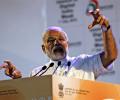
Prime Minister Narendra Modi, at the India Mobile Congress (IMC) 2026, articulated a vision for India's communications sector, emphasizing a global framework to combat cyber frauds and deepfakes. He called for India to become a hub for innovation and product development for the world. Industry leaders lauded his vision, highlighting India's robust digital infrastructure and its journey towards becoming a global technology leader, with a focus on trust, security, and responsible innovation.

The Securities and Exchange Board of India (Sebi) is developing a market-making framework with mandatory continuous quoting and repo liquidity support to deepen corporate bond liquidity and offer an alternative to bank credit, according to KVR Murty, its whole-time member.

Prime Minister Narendra Modi has urged for a global framework to combat cross-border cyber frauds and deepfakes, highlighting the need for governments, tech companies, telecom operators, and financial institutions to collaborate. Speaking at the India Mobile Congress 2026, Modi stressed that technology thrives on trust and that India is ready to share its expertise in tackling cyber threats. He also noted the rapid expansion of 5G and the success of digital governance initiatives like Direct Benefit Transfer.

NetApp CEO George Kurian advocates for harmonised global AI regulations to simplify compliance and foster business growth. He highlights the complexities arising from diverse regulatory frameworks and the importance of a unified approach, similar to cyber resilience standards. Kurian also notes India's significant role as NetApp's fastest-growing market in Asia, driven by its Bengaluru global capability centre.

Industry experts advocate for India to develop its own artificial intelligence (AI) safety framework, distinct from US or EU models, to address unique challenges like deepfakes and cyberattacks. They call for a comprehensive commitment involving all stakeholders and a hybrid regulatory approach combining voluntary and binding measures, as the Indian government also considers new AI regulations.

Beijing published the world's first global framework for vocational standards. If India does not act swiftly, it will be compelled to certify its workers by someone else's rulebook, cautions Abhay Jere, ex-Vice Chairman, AICTE.

India presented its 'Sundays on Cycle' initiative at the UN climate summit in Antalya, advocating for citizen involvement in combating climate change. The program, part of the Fit India Movement, encourages regular cycling and has seen significant participation, with UN Climate Change leaders suggesting it as a replicable global model.

Prime Minister Narendra Modi inaugurated the first SCO Civilisational Dialogue Forum in New Delhi, emphasising that cultural connections are the strongest guarantee for global peace, especially amidst current global unrest. He highlighted India's ancient trade and cultural routes, stressing that shared civilisational experiences can unite the world. The event, hosted at Purana Qila, showcased India's rich heritage and aimed to foster cultural cooperation among SCO member countries.

Prime Minister Narendra Modi emphasised the democratisation of technology to ensure no section of society is left behind, advocating for affordable and accessible digital services, especially for the Global South. He highlighted the potential of Digital Public Infrastructure (DPI) and called for solutions to cyber fraud, global standards for emerging tech, and mechanisms to identify AI-generated content during his interaction with GSMA board members.

Indian crypto exchanges and companies have expressed strong support for the Central Board of Direct Taxes' (CBDT) new Crypto Asset Reporting Framework (CARF), which mandates reporting and due-diligence obligations for crypto service providers on all transactions starting 2026.

Prime Minister Narendra Modi has introduced a 'Sapta Dhara' (seven-stream) reform framework, aiming to propel India into a developed nation by 2047. This comprehensive plan focuses on key sectors including manufacturing, agro-food processing, technology, logistics, defence, green and blue economy, and soft power, leveraging the nation's youth potential.

The Securities and Exchange Board of India (Sebi) is not in favour of extending market trading hours, citing concerns around cybersecurity and liquidity, according to chairman Tuhin Kanta Pandey. He stated that extending hours is not necessarily an efficient way and requires strong reasons, costs, and risk assessments.
The highly anticipated interim trade deal between India and the United States is currently on hold, awaiting Washington's finalisation of its internal tariff framework, even as the US has assured New Delhi of a crucial comparative tariff advantage over its global competitors.

Abhiroop Chatterjee, a PhD researcher from Jadavpur University, has been selected for the 2026 Google PhD Fellowship Programme, becoming the first from the institute to receive this global distinction. His research focuses on advancing machine learning and AI models, particularly in developing efficient representation learning approaches and addressing challenges like semantic drift and memory loss in large AI models.

The Indian government has amended direct overseas listing norms, allowing companies to list convertible debentures and preference shares, in addition to equity shares, on international exchanges in the GIFT IFSC. Unlisted public companies and those with negative net worth can also list, subject to conditions.

India's markets regulator, Sebi, is set to issue comprehensive guidelines for the responsible use of Artificial Intelligence (AI) in capital markets, aiming to balance technological innovation with robust investor protection. The guidelines will focus on disclosures, accountability, and human oversight in critical AI-driven decisions.

Former Brazil international Douglas Maicon is set to visit Kolkata on November 13-14 as a global brand ambassador for King Sports Management. His visit aims to bolster grassroots football development, youth scouting, and provide technical insights to young Indian talent, including a talent hunt programme.
Mining magnate Anil Agarwal has cautioned that the government's decision to transfer operations of a producing offshore oil and gas block from Vedanta to state-run ONGC could send a "very wrong signal" to investors, urging policymakers to maintain regulatory stability.

The SCO Civilisational Dialogue Forum, hosted by India, concluded with the adoption of the Indraprastha Communique. This outcome document advocates for the protection of cultural heritage, combating illicit trafficking, and promoting respect for all civilisations. The three-day forum, inaugurated by PM Modi, saw participation from SCO member countries, including Pakistan, and laid out a roadmap for future cultural cooperation and heritage preservation.

Prime Minister Narendra Modi, addressing the BRICS summit, called for a fundamental shift in global governance, advocating for the replacement of the current 'pyramid of privilege' with a 'platform of partnership' where the Global South becomes a 'rule shaper' rather than a 'rule follower'.
Sebi chairman Tuhin Kanta Pandey acknowledged that all global jurisdictions experienced lower liquidity during the initial implementation phases of the closing auction session (CAS), a stock price determination framework introduced in India on August 3.

The Union finance ministry has constituted a high-level committee, chaired by former Central Vigilance Commissioner Suresh N Patel, to recommend structural, regulatory, and legislative reforms for India's banking sector, aiming to make banks globally competitive and support the financing needs of a developed economy.
Paytm's current business model is already profitable, with the potential UPI merchant discount rate (MDR) framework expected to offer additional revenue rather than being the primary driver of its profitability. This assessment is supported by the company's Q2 FY27 earnings and analyses from global brokerages like JP Morgan, Goldman Sachs, and Bernstein, which highlight the strength of its merchant-led platform and financial services.

India is strategically positioned to develop a robust domestic semiconductor ecosystem, driven by increasing electronics consumption, strong government support through incentives, and a global shift in supply chains. Boston Consulting Group Managing Director Ankush Wadhera highlights India's potential as a safe haven for investments, with the AI boom further fuelling demand for advanced chips. The nation aims to expand its capabilities across the entire semiconductor value chain, attracting significant global and domestic investments.
India's IT Ministry sources state the country will not slow down its Artificial Intelligence development, distinguishing its focus on people-centric applications from global concerns over frontier models. The government acknowledges AI safety risks and is tightening incident reporting norms, with IT Minister Ashwini Vaishnaw emphasising regulation for user safety.

The Indian government has significantly simplified its visa regime, reducing main categories from 13 to nine and sub-categories from 49 to 23. This initiative also cuts down fields in visa application forms by 65-70 per cent, aiming to make the process more coherent and responsive for foreign nationals. Key changes include renaming the Tourist Visa to Visitor Visa, consolidating medical and student visas, and introducing a Production Investment Business Visa.

Modi called business communities and governments to work together to ensure usage of ethical AI as "we have to sense the potential disruptions in different sectors. This problem has to be solved under the global framework."

Indian benchmark indices Sensex and Nifty closed higher for the second consecutive day, primarily driven by robust buying in IT stocks following strong quarterly results and positive global trends. Tech Mahindra notably surged over 8% after reporting a significant jump in net profit.

Union Home Minister Amit Shah inaugurated the 12th battalion campus of the National Disaster Response Force (NDRF) at Hollongi, Arunachal Pradesh, emphasising a 'zero-casualty' approach to disaster management. The new earthquake-resistant facility aims to significantly enhance disaster preparedness and response across the vulnerable Northeast region, focusing on timely warnings, community participation, and advanced training for NDRF and SDRF personnel.

Karnataka Chief Minister D K Shivakumar announced the government's commitment to making the yellow and red Kannada flag the official state flag. He stated that a legal framework would be introduced to allow it to be flown alongside the national flag on government buildings. The matter will be discussed during the winter session of the Legislature in Belagavi. Shivakumar also highlighted the importance of preserving Kannada language and culture, outlining initiatives to strengthen public education and promote the language.

'They allow people to enter and exit. And there is transparency. There is market infrastructure. There is technology. There is cyber security. And then there are enough enablers.'

Karnataka IT Minister Priyank Kharge reviewed preparations for the 29th Bengaluru Tech Summit 2026, themed "AI & Beyond." The summit, scheduled for November 17-19, 2026, will feature over 1,800 exhibitors, focusing on AI, DeepTech, biotechnology, electronics, robotics, and startups, aiming to foster innovation and collaboration.
India's IT Secretary S Krishnan announced that the government is considering a dedicated regulatory framework for Artificial Intelligence, moving beyond existing IT rules to address challenges like deepfakes and synthetic content. This comes as global policymakers grapple with AI's rapid emergence and its implications.

Kiran Mazumdar-Shaw, Executive Chairperson of Biocon Ltd, stated that Artificial Intelligence (AI) could drastically reduce the drug development timeline from five-to-seven years to just one or two. Speaking at the Bengaluru Tech Summit, she highlighted AI's potential to revolutionise drug discovery, clinical trials, and precision medicine, urging for regulatory frameworks to keep pace with these advancements.

RBI Deputy Governor Poonam Gupta stated that India's economic growth momentum remains strong despite various global and domestic shocks, attributing this resilience to a diversified growth base and improved policy responses. She highlighted the economy's 7.8 per cent growth in Q1 and continued momentum into Q2, suggesting potential upgrades to growth forecasts.
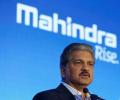
Bristlecone, a Mahindra Group company, reported a 24% year-on-year topline growth and aims for a billion-dollar valuation. The AI-powered supply chain services provider is expanding its offerings to include data analytics, AI, and product engineering, focusing on making supply chains more resilient for its global clients across high-tech, retail, manufacturing, and life sciences segments.

Sports Minister Mansukh Mandaviya announced that amendments to the National Anti-Doping Act will be introduced in the next Parliament session. These amendments aim to criminalise the trafficking and distribution of prohibited substances to athletes, imposing jail terms of up to five years for suppliers, including medical practitioners. India is committed to sporting integrity and has already strengthened its anti-doping framework, conducting extensive tests and awareness sessions.

The $6.3 billion Binance heist has renewed concerns over nation-State cyberattacks and AI-driven vulnerabilities, putting the security preparedness of crypto exchanges under scrutiny.
Bharti Airtel Chairman Sunil Mittal has called for proactive regulation of Artificial Intelligence, stating that waiting for an "accident" before implementing safeguards would be "foolish." Speaking at the Bloomberg New Economy Forum 2026, Mittal highlighted the struggle of governments to keep pace with AI's rapid growth and emphasised the need for a global regulatory framework, similar to the aviation sector, to ensure national security and responsible development.
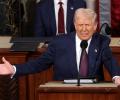
Experts suggest that a significant setback for US President Donald Trump in the midterm elections could compel him to pursue a swift trade agreement with India, as he seeks a quick foreign policy win amidst challenges with Russia, China, and Iran.
